Article Index
Property security alert in Mexico City
Between January and September 2026, 2,961 cases of despojo were recorded in Mexico City (nearly eleven a day). The crime is committed through deception, violence or stealth; detecting the intrusion in time and coordinating neighbors and building management with authorities makes all the difference.
2 free credits a day · No card
1. The problem: how they take your home without buying it
It isn't theft; it's despojo. The name matters. Whoever invades a property almost never becomes its owner: they take possession, which is what stops you from living there. The Código Penal para el Distrito Federal (Mexico City Penal Code) punishes anyone who, on their own authority and through physical or moral violence, deception, sham legal acts, identity theft or by stealth, occupies someone else's property, makes use of it or prevents its enjoyment (article 237, fracción I).
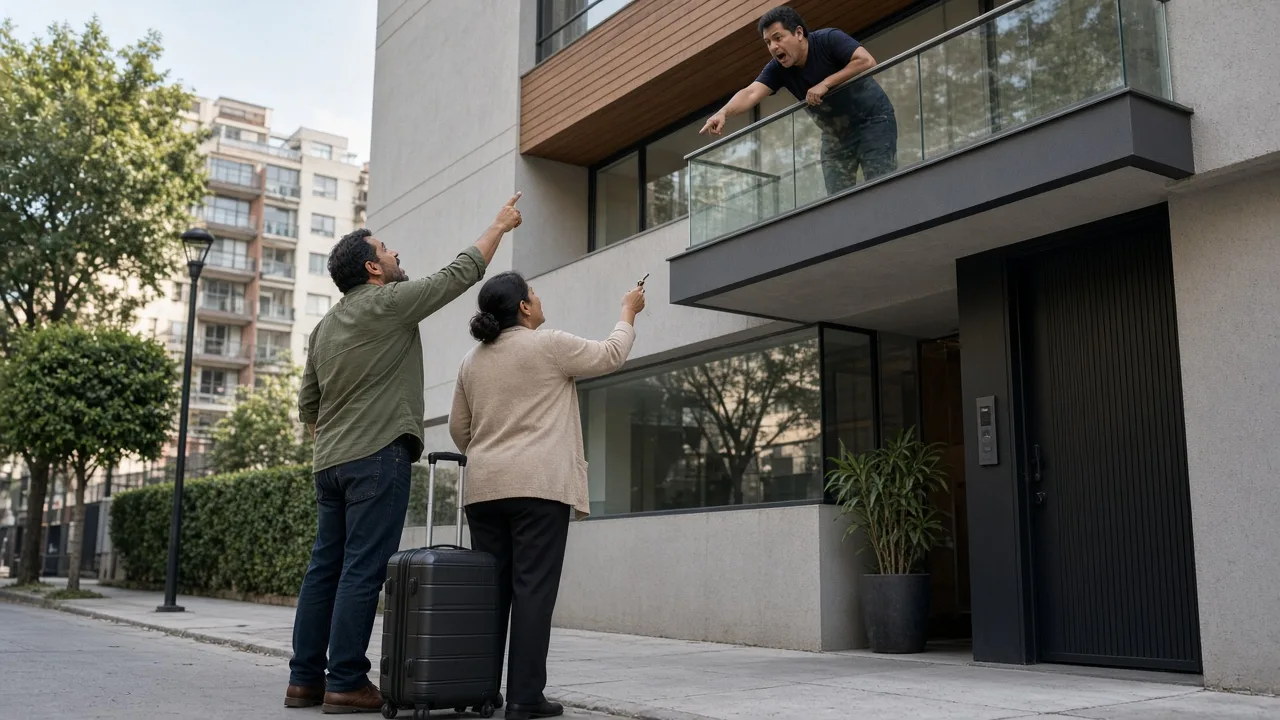
The method repeats itself. Residents of the colonia Del Valle described it to El Universal and Expansión in July 2026. First, someone walks the street ringing doorbells to see who answers and how long it takes. Days later, with the house confirmed empty, they come back with a locksmith and a moving truck, disable the cameras, change the lock and take your things out. According to the same residents, they mainly target properties belonging to older people, houses with unresolved inheritances or with unpaid predial (property tax). According to Bloomberg, there's another variant: invasions used for extortion, in which the invaders charge around 50,000 pesos to leave and 3,000 a month not to come back.
It doesn't only happen to empty houses. At Río de la Plata 21, an apartment building in the colonia Cuauhtémoc, Animal Político documented that on June 23, 2025, hooded men took over two apartments; before that, they had posed as workers on a construction job in the penthouse. On June 27, an operation by the Secretaría de Gobierno (the city government's interior department), the Fiscalía General de Justicia de la Ciudad de México (Mexico City Attorney General's Office), the INVEA (Instituto de Verificación Administrativa, the city's inspection agency) and the alcaldía (borough government) opened and sealed the invaded apartments, halted unpermitted construction and gave the residents back the rooftop, which they hadn't been able to use for more than four months (Excélsior, N+). It didn't end there: over the following eleven months there were at least four more attempts, one with fake court documents, and the condominium owners accuse at least one police officer of collusion (Animal Político). According to Bloomberg, in November 2026 the family's apartment was still taped off while the investigation continues.
The scale. The figures vary depending on who's counting:
- The Mexico City Fiscalía (FGJCDMX) opened 25,018 investigation files for despojo between January 2020 and April 2026. In that period only 463 arrests were reported, according to data obtained by Animal Político through a transparency request.
- According to Bloomberg, the capital racked up 41,081 cases over the past decade, behind the Estado de México (46,993). The Fiscalía itself, at a press conference in August 2026, spoke of an average of between 9 and 10 complaints a day since 2019.
- Not everything that gets reported is despojo. Mexico City's head of government, Clara Brugada, has said that of every ten complaints, only a third actually are. In August 2026, the Fiscalía reported that of 1,032 cases reviewed, 644 were civil or other kinds of disputes and 388 were possible despojos.
Family or gangs? According to Bloomberg, a Fiscalía investigator estimates that 70% are family matters; a specialist lawyer reckons that around 60% of her cases are down to gangs, and the Secretary of Citizen Security, Pablo Vázquez, spoke of at least four criminal groups.
Why now. According to Bloomberg, gentrification has more than doubled prices in some areas, and informality weighs in too: private agreements that never get formalized. Attorney General Bertha Alcalde has described schemes involving sham sales, identity theft, forged documents and procedural fraud. And there are internal problems: in August 2026, the Fiscalía reported that it is investigating 14 of its own officials for possible omissions and corruption in despojo cases (Expansión).
The official response. The Gabinete contra Despojos (anti-dispossession task force) coordinates the Secretaría de Gobierno (SECGOB), the Fiscalía, the Secretaría de Seguridad Ciudadana (Mexico City's public security department), the Consejería Jurídica (the city's legal affairs office) and other agencies. From March 9 to 13, 2026, for example, the SECGOB and the Policía de Investigación (investigative police) carried out 13 actions in seven alcaldías, including Benito Juárez and Cuauhtémoc: they returned apartments, homes and lots to their rightful owners, secured properties occupied without authorization and placed others under guard where seals had been broken or there had been attempts to reoccupy them (SECGOB bulletin, Mar. 15, 2026).
2. What changed in the law (and what didn't)
On November 21, 2025, the Gaceta Oficial (the city's official gazette) published a reform that toughened the offense in Mexico City:
- A base sentence of 6 to 11 years in prison and 200 to 1,000 UMA (Unidad de Medida y Actualización, the official unit used to set fines) (art. 237). Fracción I expressly names deception, sham legal acts and identity theft as means of committing it.
- An additional 7 to 11 years and 1,000 to 4,000 UMA with aggravating circumstances (art. 238): a victim over 60, with a disability or pregnant; involvement of a notary; impersonation of the owner or possessor; three or more people; forged or altered documents, or a profit motive. (The fracción on public officials was amended again on August 20, 2026.) Officials speak of sentences of up to 22 years.
- Staying is also a crime. Keeping up the occupation after the authorities have ordered you to leave is treated as equivalent to despojo (art. 238 Bis).
- The statute of limitations starts running when you get the property back, not when it was taken from you (art. 238, last paragraph).
- On the civil side, bad faith is presumed on the part of anyone whose possession rests on a sham act, and any legal act that seeks to cover up a despojo through a sham contract is void (Código Civil [Mexico City Civil Code], art. 806).
- Notaries. They are liable when, through negligence or bad faith in checking the registry or the documents, the acts they record in a deed end in a despojo (Ley del Notariado [Mexico City Notaries Law], art. 103, fr. IV).
The reform does not give you your home back automatically: you still have to prove your right and wait for the Fiscalía or a judge to act. In August 2026, the Fiscalía set out deadlines of 15 days to secure and return the property and 30 to take the case to court in invasions where the paperwork is in order; the Attorney General warned that in civil inheritance disputes those timelines are harder to meet.
3. Your condominium: what it can do and what it can't
The Ley de Propiedad en Condominio de Inmuebles para el Distrito Federal (LPCIDF, Mexico City condominium law) does not mention despojo. There's no condominium procedure for invasions and no power for the administrador (building administrator) to "recover" an apartment. There are tools, though, that make the difference between catching an invasion in time and finding out when there's already a welded-shut door.
What it can do:
- The asamblea (owners' assembly) can organize security. It is responsible for setting the condominium's security and surveillance means and measures, and how the owners take part, "with occasional support from the authorities" (art. 33, fr. XIII, printed as a second fr. XII in the current text). That covers a log of visitors and move-ins and move-outs, rules for construction workers and a protocol for what to do if someone shows up with a locksmith. Careful: the asamblea's resolutions must comply with the law (art. 33, last paragraph) and the internal rules can't discriminate (art. 53).
- The administrador looks after the common areas. They must take care of and watch over the common property and services (art. 43, fr. II) and require compliance with the law and the rules, "requesting, where appropriate, the support of the relevant authority" (fr. XVI). With respect to common property, they have powers for lawsuits and collections (fr. XVII). If the rooftop, the service room or the parking area is invaded, they can and must act through those channels.
- Any owner can file a criminal complaint. The law recognizes the right of owners and possessors to report possibly criminal acts "to the detriment of the condominium" (art. 16, fr. VII). If it's your unit that has been taken, the complaint is yours to file, but the neighbors can contribute testimony, videos and logs.
- Whoever uses a unit must give notice. When an owner hands over the use of their unit (renting it out, for example), both must notify the administrador and the asamblea with a document signed by both of them (art. 19). A missing notice doesn't prove a despojo, but if someone says "I rented it" and nobody ever gave notice, it's a warning sign worth documenting.
What it can't do:
- Throw anyone out on its own. Not the administrador, not the asamblea, not even the owner. The Código Penal also punishes as despojo anyone who, on their own authority and through violence, deception or by stealth, occupies a property they own when the law doesn't allow it because it is in another person's possession (art. 237, fr. II). That's why the authorities insist: don't take the law into your own hands. Call 911 and the Fiscalía.
- Decide who the owner is. That isn't up to the asamblea, the management or PROSOC (Procuraduría Social, Mexico City's social ombudsman). PROSOC handles disputes between owners, possessors and management through conciliation, arbitration or administrative sanctions, and the law first provides for mediation before the management or the relevant committee (arts. 63 and 64). It doesn't investigate crimes or return properties. It's for the condominium dispute that comes afterwards, such as unpaid fees, work on common areas or noise. (The government has proposed turning it into a Defensoría Social.)
Should the management tell an owner if it notices strange activity in their apartment? The LPCIDF doesn't say. It makes sense to agree on it in the asamblea: an emergency contact directory, voluntary and with careful handling of personal data. A neighbor of an invaded lot in Benito Juárez told its owner, as Bloomberg recounts: "We wanted to call you when we saw them go in, but we didn't have your phone number."
4. Prevention: what's up to you
- A registered deed. Make sure your deed is recorded in the Registro Público de la Propiedad (Public Property Registry), not just signed. The Colegio de Notarios (Mexico City College of Notaries) puts it this way: "the deed is the main form of protection against despojo."
- Activate the Registro Público's Alerta Inmobiliaria (property alert service), which the official campaign recommends to stop anyone from trying to carry out a procedure on your property without your knowing. In 2026 it costs MXN $611 a year or MXN $352 for six months per folio (property record), VAT included.
- Keep predial, water and electricity up to date. Hold on to the receipts: the official campaign itself asks you to keep them.
- Sort out inheritances and intestate estates. Inheritance problems are among the targets residents point to.
- Put any rental or loan of the property in writing and let the administrador know.
- If you'll be away for a long time, tell the management and leave an emergency contact.
- Don't sign powers of attorney, assignments or agreements without advice, and check that your notary really is one in the Colegio de Notarios directory.
If it's already happening: call 911, record from a safe place, gather your deed, receipts and IDs, ask the neighbors to keep videos and logs, and file a complaint without delay. According to the Fiscalía, evidence such as video of the invasion, deeds and electricity bills lets cases go to court faster.
5. Who to contact
- Emergency, invasion in progress: 911.
- Gabinete contra Despojos (Gobierno de la CDMX, Mexico City government): 55 5345 8120, the number the city government publicizes for reporting despojos.
- SECGOB citizen services (the department's general line, not the reporting line): Plaza de la Constitución 1, col. Centro; 55 5345 8000, ext. 1605 or 1613; atencionciudadana27@secgob.cdmx.gob.mx; Monday to Friday, 9:00 to 17:00.
- Fiscalía General de Justicia (FGJCDMX): Fiscalía specializing in despojo, Digna Ochoa y Plácido 56, col. Doctores. 24-hour phone service: 55 5200 9000. You can also file a complaint at any Ministerio Público (public prosecutor's) office; if you plan to file online, check first which crimes it accepts.
- Registro Público de la Propiedad: Alerta Inmobiliaria and certificates. Calzada Villalongín 15, 6th floor, col. Cuauhtémoc; 55 5140 1700, ext. 1208.
- Colegio de Notarios de la CDMX: free legal consultations Tuesday, Wednesday and Thursday from 16:00 to 18:00, by appointment at 55 5511 1819. Río Tigris 63, col. Cuauhtémoc.
- Defensoría "Ponciano Arriaga" (city legal aid programme): 100 lawyers give free advice in the Zócalo on Mondays from 16:00; according to La Crónica, with access via 20 de Noviembre and Venustiano Carranza (confirm before you go).
- PROSOC, only for the condominium dispute, not for the despojo: Mitla 250, col. Vértiz Narvarte; 55 5128 5200, ext. 5220.
Despojo thrives in the gaps: unregistered papers, neighbors who don't know each other, building managements that don't know what to do. The law already punishes it more harshly; finding out in time depends on your building.
This article is for information only and is not a substitute for a lawyer's advice on your case.
Sources
- Bloomberg Originals, "Inside Mexico City's Housing Theft Crisis" (video): https://www.youtube.com/watch?v=1nBjb9VBuvc
- Bloomberg Businessweek / El Financiero, "El negocio del despojo inmobiliario en CDMX: cómo bandas criminales se apoderan de miles de viviendas" (5 nov. 2026): https://www.elfinanciero.com.mx/bloomberg-businessweek/2026/11/05/el-negocio-del-despojo-inmobiliario-en-cdmx-como-bandas-criminales-se-apoderan-de-miles-de-viviendas/
- Gaceta Oficial de la CDMX, 21 nov. 2025, decreto que reforma los arts. 237, 238, 238 Bis y 248 del Código Penal; 806 del Código Civil; 41 de la Ley Registral, y 34 y 103 de la Ley del Notariado (copia en PAOT): https://paot.org.mx/centro/codigos/df/pdf/2025/GOCDMX%2021112025%20COD%20PENAL%20DF.pdf
- Código Penal para el Distrito Federal, texto vigente. Congreso de la CDMX, Marco Legal (última reforma publicada en la GOCDMX el 26 ago. 2026): https://www.congresocdmx.gob.mx/marco-legal-cdmx-107-2.html ; Consejería Jurídica CDMX: https://data.consejeria.cdmx.gob.mx/index.php/leyes/codigos/34-codigo-penal-para-el-distrito-federal ; síntesis SCJN de la GOCDMX del 20 ago. 2026 (reforma a los arts. 237 fr. III y 238 fr. III): https://www.scjn.gob.mx/sites/default/files/sintesis_dof_gocdmx/documento/2026-08/GOCDMX%2020082026%20S%C3%8DNTESIS%20BIS.pdf ; SCJN, contradicción de criterios 251/2022 (texto del art. 237, fr. II): https://www2.scjn.gob.mx/juridica/engroses/1/2022/4/2_300794_6104_firmado.pdf
- Congreso de la CDMX, "Incrementan penas al delito de despojo" (13 nov. 2025): https://www.congresocdmx.gob.mx/comsoc-incrementan-penas-al-delito-despojo-6812-1.html
- Ley de Propiedad en Condominio de Inmuebles para el Distrito Federal (texto vigente, reforma publicada el 4 ago. 2023), arts. 16, 19, 33, 43, 53, 63 y 64. Consejería Jurídica CDMX: https://data.consejeria.cdmx.gob.mx/index.php/leyes/leyes/302-leydepropiedadencondominiodeinmueblesparaeldistritofederal ; PDF (PAOT): https://paot.org.mx/centro/leyes/df/pdf/2023/LEY_PROPIED_CONDOMIN_04_08_2023.pdf
- Animal Político, "Fiscalía de CDMX abre en seis años 25 mil carpetas por despojo; sólo reporta 463 detenciones" (17 jun. 2026): https://grupoanimal.mx/estados/despojo-cdmx-carpetas-detenciones
- Animal Político, "Despojos en CDMX: en Río de la Plata 21 suman cuatro intentos…" (11 may. 2026): https://grupoanimal.mx/estados/despojos-en-cdmx-en-rio-de-la-plata-21-suman-cuatro-intentos-vecinos-apuntan-a-colusion-de-al-menos-un-policia
- Excélsior, "Vecino del terror abandona edificio en la Cuauhtémoc tras denuncias" (27 jun. 2025): https://www.excelsior.com.mx/comunidad/vecino-terror-cuauhtemoc-abandona-propiedad/1724154
- N+, "Recuperan Departamentos Despojados en Río de la Plata 21; INVEA Suspende Obras Ilegales" (27 jun. 2025): https://www.nmas.com.mx/noticieros/programas/en-punto/videos/despojo-departamentos-rio-la-plata-21-recuperan-inmuebles/
- Expansión Política, "'Llegan con cerrajero y un camión de mudanzas': el modus operandi… en la Del Valle" (27 jul. 2026): https://politica.expansion.mx/cdmx/2026/07/27/modus-operandi-despojo-colonia-del-valle
- El Universal, "Alertan por presunto modus operandi para despojar viviendas en alcaldía Benito Juárez" (24 jul. 2026): https://www.eluniversal.com.mx/metropoli/alertan-por-presunto-modus-operandi-para-despojar-viviendas-en-alcaldia-benito-juarez-vecinos-elaboran-censo-de-casos/
- Expansión Política, "14 funcionarios son investigados por despojo: Fiscalía CDMX" (25 ago. 2026): https://politica.expansion.mx/cdmx/2026/08/25/fiscalia-cdmx-investiga-funcionarios-despojo
- Infobae, "CDMX toma medidas contra el despojo de viviendas: fiscalía especializada, 20 jueces dedicados y alerta registral" (5 ago. 2026): https://www.infobae.com/mexico/2026/08/05/cdmx-toma-medidas-contra-el-despojo-de-viviendas-fiscalia-especializada-20-jueces-dedicados-y-alerta-registral/
- Jefatura de Gobierno CDMX, transcripción de la conferencia sobre protección del patrimonio familiar (5 ago. 2026; decálogo, plazos, cifras de la Fiscalía y teléfono del Gabinete): https://jefaturadegobierno.cdmx.gob.mx/comunicacion/nota/transcripcion-de-las-palabras-de-la-jefa-de-gobierno-clara-brugada-molina-de-secretarios-de-su-gabinete-y-otros-funcionarios-en-conferencia-de-prensa-sobre-proteccion-del-patrimonio-familiar-acciones-para-restituir-la-propiedad-y-prevenir-el-despojo
- Jefatura de Gobierno CDMX, "Pone en marcha Clara Brugada, Defensoría Social 'Ponciano Arriaga'…" (24 ago. 2026): https://jefaturadegobierno.cdmx.gob.mx/comunicacion/nota/pone-en-marcha-clara-brugada-defensoria-social-ponciano-arriaga-100-abogados-garantizaran-acceso-igualitario-la-justicia
- Secretaría de Gobierno CDMX, "Avanza estrategia contra el despojo: restituyen inmuebles y aseguran predios en la Ciudad de México", BOL-SECGOB-016-2026 (15 mar. 2026): https://www.secgob.cdmx.gob.mx/comunicacion/nota/BOL-SECGOB-016-2026
- La Crónica de Hoy, "Asesoría jurídica gratuita en el Zócalo CDMX…" (26 oct. 2026): https://www.cronica.com.mx/metropoli/2026/10/26/asesoria-juridica-gratuita-en-el-zocalo-cdmx-cuando-es-a-que-hora-inicia-y-como-acceder-al-programa/
- FGJCDMX, directorio de la Agencia del Delito de Despojo: https://www.fgjcdmx.gob.mx/secretaria/estructura/500 ; servicios en línea: https://www.fgjcdmx.gob.mx/nuestros-servicios/en-linea ; atención telefónica: https://www.fgjcdmx.gob.mx/nuestros-servicios/servicios-la-ciudadania/servicios-de-atencion-telefonica
- Consejería Jurídica CDMX, Registro Público, Alerta Inmobiliaria: https://servicios.consejeria.cdmx.gob.mx/cmscejur/dgrppc/alerta-inmobiliaria-info/ ; cuotas 2026 (Gaceta Oficial, 11 feb. 2026): https://servicios.consejeria.cdmx.gob.mx/cmscejur/export/sites/portal-consejeria/dgrppc/DGRPPC/CIRCULAR/2026/Publicacion-de-Cuotas-2026.pdf
- Colegio de Notarios de la CDMX, Consultorías Jurídicas Gratuitas: https://colegiodenotarios.org.mx/consultoria-gratuita ; postura sobre despojo (30 jul. 2026): https://colegiodenotarios.org.mx/postura-institucional-notariado-cdmx-sobre-despojo
- Procuraduría Social CDMX, oficinas y contacto: https://www.prosoc.cdmx.gob.mx/contacto/oficinas-prosoc