Article Index
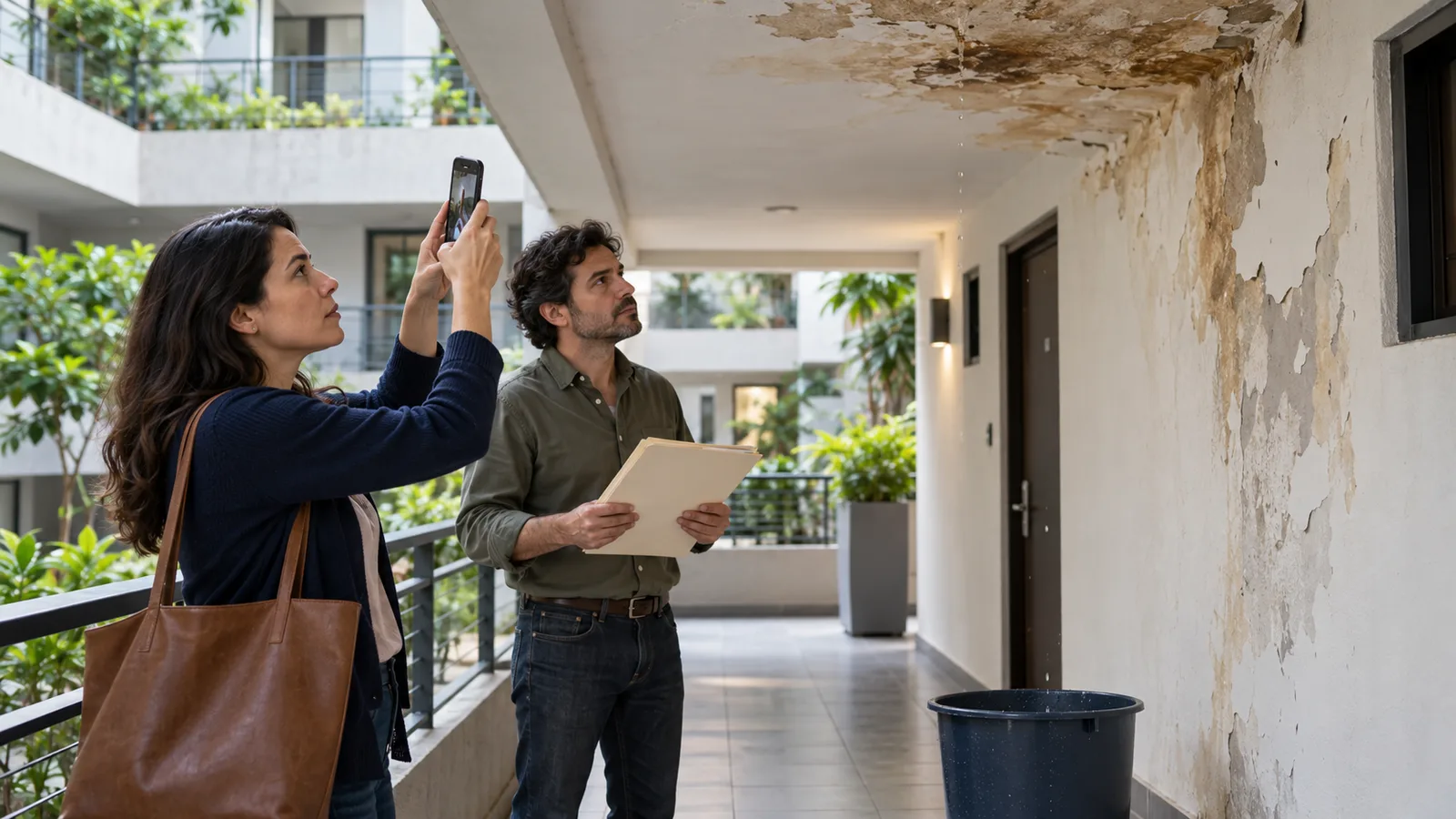
The leak returns with every rainfall. The gate has been broken for weeks. Photos, messages, and promises of repair pile up in the neighbors' chat group. Maintenance fees, however, arrive punctually.
2 free credits a day · No card
Then someone proposes what many are thinking: "If they don't fix anything, let's stop paying."
The frustration is understandable. The decision can prove costly. In Mexico City, a lack of maintenance does not, by itself, authorize suspending validly established maintenance fees. But paying does not force anyone to accept a property management that fails to respond.
The obligation to contribute and the right to demand proper management coexist. Fulfilling one does not mean forfeiting the other.
The short answer: you cannot suspend fees solely because repairs are pending
Article 56 of the Mexico City Condominium Property Law establishes that ordinary and extraordinary administration and maintenance fees are not subject to compensation or personal exceptions excusing their payment.
This prevents treating the fee as a commercial payment that each resident may withhold whenever service is considered deficient. Funds constitute common building reserves: they maintain services, conservation, and building obligations, beyond the specific repairs causing grievance.
The rule also has a direct practical consequence: paying for a repair out of your own pocket does not authorize unilaterally deducting it from your fees. The eligibility for reimbursement and the duty to pay maintenance must be addressed through their appropriate channels.
The same article provides an avenue for individuals who demonstrate a lack of resources or declared insolvency: the assembly may agree that fees be covered through work for the benefit of the condominium. It is not an automatic exemption nor a unilateral decision that a resident may take independently. Article 56, page 45 of official PDF.
What changes if you stop paying
The risk is not limited to receiving collection reminders from management. The law provides economic, governance, and judicial enforcement consequences.
Default interest and arrears
Articles 33, fraction V, and 59 regulate default interest on overdue fees. Article 33 establishes a ceiling of nine percent annually for statutory default interest. The underlying agreement or Internal Bylaws must be reviewed: management does not have discretion to invent arbitrary interest rates.
Voting restrictions, with explicit exceptions
Article 34 considers delinquency, among other conditions, the non-payment of two or more fees to the maintenance, administration, and reserve funds, or of one extraordinary fee according to its terms. It also includes unliquidated damages ordered by final judicial judgment or arbitral award.
As a general rule, the delinquent owner or possessor’s vote is suspended, but their voice is preserved. Express exceptions exist: assemblies called to modify the Constitutive Deed, extinguish the condominium property regime, or affect property ownership. Therefore, it is inaccurate to claim that an owner behind on fees forfeits their vote in every single assembly.
Judicial collection, subject to strict requirements
Article 59 provides a summary civil enforcement action starting from two overdue ordinary fees or one extraordinary fee. A simple debtor list prepared by management does not suffice: the statute requires a statement of liquidation signed by both the administrator and the Oversight Committee president, official payment receipts, and certified copies of the assembly minutes or Internal Bylaws supporting the claimed obligations.
A lawsuit does not mean an automatic judgment. The debt and procedural prerequisites must be formally proven in court.
Entering delinquency does not erase the physical damage nor legitimize management inaction. It adds a payment problem to a maintenance dispute. Articles 33, 34 and 59 of official statute.
Paying does not mean accepting any fee uncritically
The obligation to cover fees does not make every charge appearing on an account statement unquestionable. Articles 33, fraction V, 43, fraction IX, and 55 tether contributions directly to assembly resolutions and governing rules.
If an extraordinary fee is unrecognized, duplicate charges appear, or amounts are disputed, request legal grounding: assembly minutes, purpose, amount, due date, and distribution criteria. Request written correction and retain all payment vouchers.
Questioning a specific charge differs from suspending all contributions as a protest. Where genuine controversy exists, seek guidance on how to contest it formally without compounding arrears. Articles 33, 43 and 55.
Management does have legal obligations regarding decay
Article 43 obliges the property manager to safeguard common property and services, attend to facility operations, and execute necessary acts of administration and conservation. Fraction VII expressly refers to works under Article 26, fraction I.
The latter governs works necessary for the security, stability, and conservation of the condominium and service functionality. It provides for assembly conformity, appropriate construction formalities, and charges to the maintenance fund, reported in the next assembly. If funds are insufficient or unforeseen works required, management must convene an extraordinary assembly.
"There is no money" may describe an actual problem; it does not substitute an account statement, a technical diagnostic, nor the assembly convocation required to resolve financing.
Nor does every delay constitute serious default per se. What damage was reported, when it was known, what risks exist, what permits are needed, and what steps were taken must all be examined. Accountability must be grounded in facts.
Before assigning expenses to common funds, identify the source of damage. A water leak may originate from common rooftop areas or private unit installations. Articles 23 and 24, along with the Constitutive Deed and technical diagnostics, distinguish involved responsibilities. Articles 23, 24, 26 and 43.
From ignored messages to a documented demand
1. Turn the defect into a formal file
Record location, dates, photographs, prior reports, and responses received. Explain how building use is impaired and whether safety risks exist. Retain proof of delivery; avoid relying on fragmented messaging in community chats.
Request a concrete response: diagnostic, provisional protective measures, quotes, funding sources, and action timeline. If you propose a response deadline, clarify it reflects urgency rather than a universal statutory repair period.
2. Demand accounts that enable informed decisions
Article 43, fraction XII, obliges delivering monthly financial statements to each owner, endorsed by the Oversight Committee. It must disclose revenues, expenditures, outstanding dues, balances, and vendor commitments.
The same fraction grants eight days, counted from the day after delivery, to submit observations or objections. Once elapsed, conformity is presumed pending assembly approval. Submit observations in writing and retain copies.
3. Request the Oversight Committee to act
Article 49 obliges the committee to inspect documents, supervise managerial duties, and report irregularities. It is not merely an intermediary to forward complaints.
If an assembly is needed and management fails to call it within three days following written demand, fraction X empowers the committee to convene it under Article 32 formalities. That three-day timeframe refers to issuing the convocation, not completing repairs.
4. Bring structured proposals to assembly
An effective agenda should include diagnostics, priority repairs, contractor estimates, budget, financing mechanism, assignees, and follow-up milestones. In cases of financial discrepancy, Article 33, fraction XIX, permits the assembly to commission an external professional audit.
Convocation, quorum, and voting must strictly follow the law. In extreme emergencies, Article 32, fraction V, permits extraordinary convocation with the advance notice demanded by circumstances, maintaining all other formal safeguards. Articles 32, 33, 43 and 49.
If management defaults, can the administrator be replaced?
Yes. Article 33, fraction II, empowers the assembly to appoint, ratify, and remove property managers under statutory terms. Fraction XVII provides for revoking designations due to Article 43 breaches, notifying PROSOC to cancel registration.
Article 43's closing paragraph requires a petition backed by at least twenty percent of owners to proceed with revocation for default, duly ratified by assembly. Collecting signatures does not automatically dismiss management.
That twenty percent threshold should not be confused with convocation rules: Article 32 establishes varying percentages based on building size. It also allows PROSOC intervention, upon request of at least ten percent of owners, if administration or committee refuse to call an assembly.
Removal must be formally recorded. Upon appointing new management, Article 44 requires delivering all records and property within seven calendar days following appointment, unless judicial ruling defers delivery. Articles 32, 33, 43 and 44.
What PROSOC can do
Article 63 provides three channels: conciliation, arbitration and the administrative sanctions procedure; Articles 64 to 73 govern conciliation and arbitration. These are distinct venues: filing a complaint does not trigger immediate fines nor guarantee instant repairs.
To initiate conciliation, Article 64 requires proving that prior internal mediation was exhausted and legal standing, and specifying in the complaint the acts being challenged and the reasons. Petitions, delivery notices, responses, and committee interventions are critical evidence. Arbitration requires explicit written consent under Article 67.
Prepare a concise timeline: what occurred, since when, to whom it was reported, what response occurred, and requested remedies. Check current requirements directly with PROSOC. When damages require monetary compensation or exceed administrative jurisdiction, civil judicial proceedings may be required. Articles 63 to 67.
Three situations that should not be confused
"There is immediate danger"
If damage poses immediate peril, prioritize life safety: clear the area and contact emergency services or Civil Protection. Administrative complaints do not substitute emergency response or technical stabilization.
The law provides a specific remedy for the absence of an administrator: Article 26, fraction V, permits an owner to perform urgent repairs on common property with prior Oversight Committee authorization, providing a full report to the next assembly. It establishes reimbursement shared equally. It is not an open license to commission work and deduct it from dues.
"I want to pay, but they refuse to accept my payment"
Holding funds in your personal account does not equal payment. Article 59 expressly acknowledges judicial consignation of the full debt before civil courts, maintaining currency and notifying management in writing.
If payments are rejected or obstructed, consult formal consignation procedures. It is not payment suspension, nor does an arbitrary bank deposit suffice. The Mexico City Judiciary publishes guidance on civil consignations.
"They threaten to cut off water supply"
Article 33, fraction XII, explicitly prohibits cutting off drinking water due to arrears. The authority to pursue delinquent debts does not authorize overriding this statutory ban. The same provision regulates other services under specific assembly resolutions; it grants management no arbitrary power to shut off utilities independently. Articles 26, 33 and 59.
Pay and demand: two responsibilities that must be upheld
The next rainstorm should not find the community arguing over the same leak with fewer resources. Keeping dues current preserves voting rights and standing; documenting omissions allows demanding verifiable answers.
The objective is tangible: establishing a technical diagnostic, an assembly agreement, verified funds, and traceable execution. If management fails, the community has lawful mechanisms to review, claim, and replace it.
Paying is not resignation. Demanding repairs does not require becoming a delinquent debtor.
Sources and legal scope
- Ley de Propiedad en Condominio de Inmuebles para el Distrito Federal: official statutory text from the CDMX Congress, cross-referenced with official text. Articles 23, 24, 26, 32, 33, 34, 43, 44, 49, 55, 56, 59 and 63 to 67.
- Legislation Catalogue of the CDMX Congress and Legal Counsel Record (Consejería Jurídica): last reform indicated, August 4, 2023. Accessed: October 3, 2026.
- Judicial Power of Mexico City: civil consignations.
General guidance for Mexico City (CDMX). The Constitutive Deed, Internal Bylaws, valid assembly agreements, and case facts must be evaluated alongside applicable statutes. This article does not substitute individual legal representation.
2 free credits a day · No card